Loading...
Searching...
No Matches
Public Member Functions |
Static Public Member Functions |
Public Attributes |
Static Public Attributes |
Properties |
Events |
List of all members
SimplePolygon Class Reference
This class is subject to change. Programs using this class may require changes with a new version of VirtualLab.
Public class which defines a simple polygon (defined by an array of vertices). 'Simple' means, that there are no intersections of the vertices.
More...
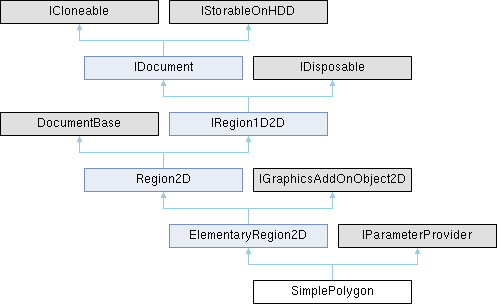
Inheritance diagram for SimplePolygon:
Public Member Functions | |||||
| override void | CalculateAxisAlignedBoundingBox () | ||||
| Method for (re)calculating the axis aligned bounding box. | |||||
| override double | CalculateDistanceOfPointToRegionBorder (VectorD point) | ||||
| Calculates the distance of a point to the border of this region. | |||||
| List< double > | CalculateInternalAngles () | ||||
| Method which calculates all internal angles of the polygon. | |||||
| VectorD[] | CalculateIntersectionsOfHalfLineAndPolygon (VectorD startPositionOfHalfLine, VectorD directionOfHalfLine, string linesName, bool ignoreVirtualVertices, out string[] namesOfPoints) | ||||
| Method for calculating the intersection points of a given half line and this polygon. | |||||
| List<(VectorD intersectionPoint, string nameOfPoint)> | CalculateIntersectionsOfLineAndPolygon (VectorD firstPointOnLine, VectorD secondPointOnLineOrDirectionOfLine, bool directionGivenInsteadOfSecondPointOnLine, string linesName, bool ignoreVirtualVertices, out List<(int edgeStart, int edgeEnd)> congruentEdges) | ||||
| Method for calculating the intersection points of a given line and this polygon. | |||||
| VectorD[] | CalculateIntersectionsOfLineSegmentAndPolygon (VectorD startPositionOfSegment, VectorD endPositionOfSegment, string linesName, string nameOfSegmentStart, string nameOfSegmentEnd, bool ignoreVirtualVertices, out(string, string)[] namesOfPoints) | ||||
| Method for calculating the intersection points of a given line segment and this polygon. | |||||
| override object | Clone () | ||||
| Deep copy of the object. | |||||
| new void | DeserializationPostProcessing (ref List< System.Reflection.FieldInfo > unfindableFields, RemainingData remainingData) | ||||
| Method for doing post-processing after XML deserialization. Especially, handling of fields which have been altered since the version the data were saved with. But also additional operations (like filling caching variables etc.) can be done here. | |||||
| override bool | Equals (object obj, EqualityIntent equalityIntent) | ||||
| Equality operator. | |||||
| void | ExtrapolatedRegionBorders (RectanglePhysical boundingBox, out List< Tuple< bool, double > > leftBorders, out List< Tuple< bool, double > > topBorders, out List< Tuple< bool, double > > rightBorders, out List< Tuple< bool, double > > bottomBorders) | ||||
| Determine region borders that can be created by 'border continuation' extrapolation. //See ITN.064 for more information. | |||||
| PolygonVertexList | Get_EffectiveVertices () | ||||
| Method which creates a new PolygonVertexList containing only effective vertices. | |||||
| override int | GetHashCode () | ||||
| override InsideOutside | GetInOutRelation (VectorD point, ExtrapolationInfo extrapolation2use=null) | ||||
| Method which checks whether or not a point lies inside or outside the 2D region or on its boundary. | |||||
| InsideOutside | InOutRelation_boundingBoxBorder_extrapolated (VectorD point, RectanglePhysical boundingBox, List< Tuple< bool, double > > leftBorders, List< Tuple< bool, double > > topBorders, List< Tuple< bool, double > > rightBorders, List< Tuple< bool, double > > bottomBorders, ExtrapolationInfo extrapolation2use) | ||||
| If a simple polygon is used inside a composed region, we may need a special handling for points near a given bounding box. If there are edges of neighbored vertices exactly on a border of the bounding box, the border may effectively disappear in case of 'periodic' or 'border continuation' extrapolation. See ITN.064 for more information on the mode 'border continuation'. | |||||
| override void | MayBeNonzeroOutside (out bool maybeNonZeroLeft, out bool maybeNonZeroRight, out bool maybeNonZeroBottom, out bool maybeNonZeroTop) | ||||
| Method which determines whether or not non zero values (i.e. 'inside' states) may appear outside the polygon in case of 'border continuation' extrapolation. | |||||
| SimplePolygon () | |||||
| Default constructor, creating a triangle with an edge length of 5mm, centered at (0, 0), and with its base line parallel to the x-axis. | |||||
| SimplePolygon (bool useOnlyEffectiveVertices=true, VectorD[] vertices) | |||||
| Initializes a new instance of the SimplePolygon class out of a list of VectorD. Each vertex gets the name "Vertex" and a running number. The boundaries are regarded as being outside, which you can change with the BoundariesAreInside property. | |||||
| SimplePolygon (PolygonVertexList vertices, bool boundaryIsInside=false, PhysicalProperty propertyOfCoordinatesX=PhysicalProperty.Length, PhysicalProperty propertyOfCoordinatesY=PhysicalProperty.Length, bool dontCheckConsistency=false, bool useOnlyEffectiveVertices=true) | |||||
| A constructor of the simple polygon class. Non-simple polygons (where at least two edges intersect) are not allowed. The constructor determines the type of the polygon. | |||||
| SimplePolygon (RectanglePhysical rectangle, bool boundaryIsInside=false) | |||||
| Constructor which gets a rectangle that shall be represented by a polygon. | |||||
| SimplePolygon (RectangularRegion rectangle) | |||||
| Constructor which gets a rectangular region which shall be represented by a polygon. | |||||
| SimplePolygon (SimplePolygon polygon) | |||||
| copy constructor of the simple polygon class | |||||
| override void | UpdatePropertyOfCoordinates () | ||||
| Method for handling update after change of the physical property of the coordinate. | |||||
| Public Member Functions inherited from ElementaryRegion2D | |||||
| double | CalculateDistanceOfPointToRegionBorder (VectorD point) | ||||
| Calculates the distance of a point to the border of this region. | |||||
| ElementaryRegion2D (bool boundariesAreInside, PhysicalProperty propertyOfCoordinatesX=PhysicalProperty.Length, PhysicalProperty propertyOfCoordinatesY=PhysicalProperty.Length) | |||||
| Constructor which gets the _boundariesAreInside flag. To be called from derived classes constructors. | |||||
| ElementaryRegion2D (ElementaryRegion2D region2bCopied) | |||||
| Copy constructor. | |||||
| Public Member Functions inherited from Region2D | |||||
| void | CalculateAxisAlignedBoundingBox () | ||||
| Method for (re)calculating the axis aligned bounding box. | |||||
| override object | Clone () | ||||
| Clones the current object. | |||||
| override bool | Equals (object obj, EqualityIntent equalityIntent) | ||||
| Equality operation. | |||||
| override int | GetHashCode () | ||||
| InsideOutside | GetInOutRelation (VectorD point, ExtrapolationInfo extrapolation2use=null) | ||||
| Method which checks whether or not a point lies inside or outside the 2D region or on its boundary. | |||||
| override FormDocument | GetNewDocumentWindow (Form formMain, string fileName) | ||||
Gets a new document window containing this document.
| |||||
| bool | IsInside (double pointX, double pointY) | ||||
| Method which checks whether or not a point is inside the 2D region. | |||||
| bool | IsInside (VectorD point) | ||||
| Method which checks whether or not a point is inside the 2D region. | |||||
| void | MayBeNonzeroOutside (out bool maybeNonZeroLeft, out bool maybeNonZeroRight, out bool maybeNonZeroBottom, out bool maybeNonZeroTop) | ||||
| Method which determines whether or not the region can provide "inside" state outside of its boundary interval. This is not the case for extrapolation mode 'ConstantZero', of course. | |||||
| Region2D (bool boundariesAreInside, PhysicalProperty propertyOfCoordinatesX=PhysicalProperty.Length, PhysicalProperty propertyOfCoordinatesY=PhysicalProperty.Length) | |||||
| Constructor which gets the _boundariesAreInside flag. To be called from derived classes constructors. | |||||
| Region2D (Region2D region2bCopied) | |||||
| Copy constructor. | |||||
Static Public Member Functions | |
| static VectorD | CalculateCentroid (SimplePolygon polygon) |
| Calculates the centroid of a given polygon. Formula taken from Wikipedia. | |
| static List< SimplePolygon > | CalculateIntersectionOfTwoPolygons (SimplePolygon polygon1, SimplePolygon polygon2, bool ignoreVirtualVertices) |
| Method for calculating the intersection of two polygons. See ITN.067 for more information. | |
| static ? SimplePolygon | CalculateUnionOfTwoPolygons (SimplePolygon polygon1, SimplePolygon polygon2, bool ignoreVirtualVertices, out List< SimplePolygon >? holes) |
| Method for calculating the union of two polygons. See ITN.067 for more information. | |
| static bool | CheckPolygonalChainForConvexityAndMonotony (VectorD[] polygonalPoints, out bool monotone_inX, out bool monotone_inY, out RectangleD boundingBox, out List< int > minX_vertexIndices, out List< int > maxX_vertexIndices, out List< int > minY_vertexIndices, out List< int > maxY_vertexIndices) |
| Check whether a polygonal chain is convex and monotone. | |
| static ? List<(string nameOfVertex1, string nameOfVertex2, bool criticalX, bool criticalY)> | CheckPolygonForCoordinateDifferencesWhichAreNumericalCritical (SimplePolygon polygon) |
| Method which checks the vertices of a given SimplePolygon whether or not it contains (neighbored) vertices whose x- or y-coordinates are not identical but so close that numerical problems are probable. | |
| static SimplePolygon | EnsureClockwisePolygon (SimplePolygon polygon2check) |
| Method which checks whether the vertices of a polygon are given in clockwise order. If so, it will be returned unchanged. If not, a polygon with reversed vertex order is returned. | |
| static SimplePolygon | EnsureCounterClockwisePolygon (SimplePolygon polygon2check) |
| Method which checks whether the vertices of a polygon are given in counterclockwise order. If so, it will be returned unchanged. If not, a polygon with reversed vertex order is returned. | |
| static List<(long index, VectorD point)> | ExtendConvexPolygonWithOutlyingPoint (SimplePolygon polygon, List< long > pointIndicesOfPolygonVertices, NamedPolygonVertex singlePoint, long pointIndexOfSinglePoint, out List< TriangulationTriangle2D > newTrianglesForExtension) |
| // Calculates the area of a given polygon. Formula taken from Wikipedia. // | |
| static InsideOutside | IsInsideTriangle (VectorD point, VectorD vertex1, VectorD vertex2, VectorD vertex3, bool useNumericalChecks=true) |
| Fast method for checking whether a point lies inside a given triangle. Important: No check for collinearity is done (for performance reasons). | |
| static bool | IsSelfIntersecting (VectorD[] vertices, out double areaWithSign) |
| Method which checks whether or not a polygon (for the given order of the vertices!) is self intersecting. | |
| static bool | operator!= (SimplePolygon o1, SimplePolygon o2) |
| Unequals operator. | |
| static bool | operator== (SimplePolygon o1, SimplePolygon o2) |
| Equals operator. | |
| static SimplePolygon | RemoveVirtualVertices (SimplePolygon polygon) |
| Method for creating a polygon without virtual vertices from an arbitrary polygon. | |
| static SimplePolygon | Rotate (SimplePolygon polygon, double angle, VectorD centerOfRotation) |
| Static method for transforming a given polygon to another one which is rotated by an angle around a given rotation center. | |
| static SimplePolygon | Scale (SimplePolygon polygon, double factor) |
| Static method for scaling a given polynom while keeping the center of its bounding box. See also the more general method TransformToTargetBox. | |
| static SimplePolygon | TransformToTargetBox (SimplePolygon polygon, RectanglePhysical targetBoundingBox) |
| Static method for transforming a given polygon to another one with defined position and size. | |
| static SimplePolygon | Translate (SimplePolygon polygon, VectorD translationVector) |
| Static method for transforming a given polygon to another one which is translated by a given vector. | |
| Static Public Member Functions inherited from ElementaryRegion2D | |
| static bool | operator!= (ElementaryRegion2D o1, ElementaryRegion2D o2) |
| Unequals operator. | |
| static bool | operator== (ElementaryRegion2D o1, ElementaryRegion2D o2) |
| Equals operator. | |
| Static Public Member Functions inherited from Region2D | |
| static Region2D | InvertRegion (Region2D region2Invert) |
| Creates a new region with inverted in / out regions compared to this. | |
| static Region2D | Load (string fileName) |
| Loads the specified file name. Works independently from whether the document has been saved without view settings (as prior to VL 6.0) or with view settings. | |
| static bool | operator!= (Region2D o1, Region2D o2) |
| Unequals operator. | |
| static bool | operator== (Region2D o1, Region2D o2) |
| Equals operator. | |
Public Attributes | |
| int | startIndexOfNearestEdge |
| Calculates the distance of a point to the border of this polygon. Important: This method will ignore all extrapolation settings! | |
Static Public Attributes | |
| const string | NameOfRectanglesCorner_BL |
| Vertex name of the bottom left corner of a rectangle which is represented as SimplePolygon. | |
| const string | NameOfRectanglesCorner_BR |
| Vertex name of the botom right corner of a rectangle which is represented as SimplePolygon. | |
| const string | NameOfRectanglesCorner_TL |
| Vertex name of the top left corner of a rectangle which is represented as SimplePolygon. | |
| const string | NameOfRectanglesCorner_TR |
| Vertex name of the top right corner of a rectangle which is represented as SimplePolygon. | |
| const double | ThresholdForNumericalCriticalDifference |
| Threshold below which a coordinate difference is considered critical. To be used by the method CheckPolygonForCoordinateDifferencesWhichAreNumericalCritical. | |
| static List< NamedPolygonVertex > | upperChain |
| Method which decomposes a suitable polygon into two separate polygonal chains, an upper and a lower one. | |
| Static Public Attributes inherited from Region2D | |
| const string | DefaultDocumentName |
| The default document name (= type description) for an Order Collection. | |
| static readonly string | FileDialogFilterString |
| The filter string used in "Open File" dialogs. | |
| const string | FileExtensionString |
| The file extension for an Order Collection. | |
Properties | |
| double | Area [get] |
| Gets the area of the polygon. | |
| bool | CounterClockwise [get] |
| Gets whether or not the polygon is defined counterclockwise. It is determined during preprocessing. | |
| virtual List< Parameter > | ParameterRunParameters [get] |
| Gets all available parameters. For variable parameters (i.e. those double and int parameters which can be used in the Parameter Run, Parametric Optimization and so on) add a VaryParameterInfo object (derived from Parameter class) to the returned list. | |
| PolygonType | Type [get] |
| Gets the type of the polygon. It is determined during preprocessing. | |
| PolygonVertexList | Vertices [get] |
| public property to get the vertices of the polygon | |
| Properties inherited from Region2D | |
| RectanglePhysical | AxisAlignedBoundingBox [get] |
| Gets the bounding box for the 2D region. Its sides are parallel to the x- and y-axis resp. | |
| bool | BoundariesAreInside [get, set] |
| Gets or sets whether or not the boundaries of the region belong to the inner region. | |
| string | CommentOfCoordinates_X [get, set] |
| Gets and sets the comment for the x-coordinates. | |
| string | CommentOfCoordinates_Y [get, set] |
| Gets and sets the comment for the y-coordinates. | |
| ExtrapolationInfo | ExtrapolationHandling [get, set] |
| The extrapolation mode for this region. See ITN.064 for more information on the mode 'border continuation'. | |
| bool | IsOneD [get] |
| Gets whether this IRegion1D2D is 1D or 2D. | |
| string | Name [get, set] |
| The name which can be given to the region by the user. | |
| PhysicalProperty | PropertyOfCoordinatesX [get, set] |
| Physical property of the x-coordinates of the region. | |
| PhysicalProperty | PropertyOfCoordinatesY [get, set] |
| Physical property of the y-coordinates of the region. | |
| Region2DType | RegionType [get] |
| Gets the type of the region. | |
| SamplingParameters | SamplingForUsageWithComplexFields [get, set] |
| Sampling parameters which will be used for a coordinate rescaling in case of using the region with a complex field. | |
| Properties inherited from IDocument | |
| VirtualLabSession | Session [get, set] |
| every documents need to be handled in a session ==> default is the VirtualLab Mainsession | |
| NodeVLExplorer | TreeStructure [get] |
| every document should have a node (maybe with subnodes) in the VirtualLab Explorer | |
| DocumentType | TypeOfDocument [get] |
| Gets an enum entry specifying the type of the document. | |
Events | |
| EventHandler? | PolygonChanged |
| Event for changed vertices. | |
Detailed Description
This class is subject to change. Programs using this class may require changes with a new version of VirtualLab.
Public class which defines a simple polygon (defined by an array of vertices). 'Simple' means, that there are no intersections of the vertices.
Constructor & Destructor Documentation
◆ SimplePolygon() [1/5]
| SimplePolygon | ( | bool | useOnlyEffectiveVertices = true, |
| VectorD[] | vertices ) |
Initializes a new instance of the SimplePolygon class out of a list of VectorD. Each vertex gets the name "Vertex" and a running number. The boundaries are regarded as being outside, which you can change with the BoundariesAreInside property.
- Parameters
-
vertices The vertices of the polygon. useOnlyEffectiveVertices If true, only effective vertices (instead of all defined vertices) will be used.
- Exceptions
-
System.ArgumentException At least three vertices must be given. System.ArgumentException Vertices have to be unique.
◆ SimplePolygon() [2/5]
| SimplePolygon | ( | PolygonVertexList | vertices, |
| bool | boundaryIsInside = false, | ||
| PhysicalProperty | propertyOfCoordinatesX = PhysicalProperty::Length, | ||
| PhysicalProperty | propertyOfCoordinatesY = PhysicalProperty::Length, | ||
| bool | dontCheckConsistency = false, | ||
| bool | useOnlyEffectiveVertices = true ) |
A constructor of the simple polygon class. Non-simple polygons (where at least two edges intersect) are not allowed. The constructor determines the type of the polygon.
- Parameters
-
vertices The vertices that define the polygon. The order is important. boundaryIsInside Flag which says whether or not the boundary is part of the inner region or not. propertyOfCoordinatesX Physical property of the x-coordinate. propertyOfCoordinatesY Physical property of the y-coordinate. dontCheckConsistency If true, no consistency check will be done. (Make sure that you know what you're doing!)useOnlyEffectiveVertices If true, only effective vertices (instead of all defined vertices) will be used.
- Exceptions
-
System.ArgumentNullException System.ArgumentException Not enough vertices specified. or Duplicate vertices found.
◆ SimplePolygon() [3/5]
| SimplePolygon | ( | SimplePolygon | polygon | ) |
copy constructor of the simple polygon class
- Parameters
-
polygon the polygon which shall be copied
◆ SimplePolygon() [4/5]
| SimplePolygon | ( | RectanglePhysical | rectangle, |
| bool | boundaryIsInside = false ) |
Constructor which gets a rectangle that shall be represented by a polygon.
- Parameters
-
rectangle Rectangle to be converted to a polygon. boundaryIsInside Flag which says whether or not the boundary is part of the inner region or not.
◆ SimplePolygon() [5/5]
| SimplePolygon | ( | RectangularRegion | rectangle | ) |
Constructor which gets a rectangular region which shall be represented by a polygon.
- Parameters
-
rectangle Rectangle to be converted to a polygon.
Member Function Documentation
◆ CalculateCentroid()
|
static |
Calculates the centroid of a given polygon. Formula taken from Wikipedia.
- Parameters
-
polygon Polygon to calculate the centroid for.
- Returns
- The centroid for the given polygon.
◆ CalculateDistanceOfPointToRegionBorder()
| override double CalculateDistanceOfPointToRegionBorder | ( | VectorD | point | ) |
Calculates the distance of a point to the border of this region.
- Parameters
-
point Point to calculate the distance for.
- Returns
- The distance of the given point to the border of this region
◆ CalculateInternalAngles()
| List< double > CalculateInternalAngles | ( | ) |
Method which calculates all internal angles of the polygon.
- Returns
- A list of all internal angles. Negative values indicate concave vertices.
◆ CalculateIntersectionOfTwoPolygons()
|
static |
Method for calculating the intersection of two polygons. See ITN.067 for more information.
- Parameters
-
polygon1 First of the polygons to intersect. polygon2 Second of the polygons to intersect. ignoreVirtualVertices If true, only effective vertices are used. That will be sufficient for most geometrical cases. If it is about triangulation, all vertices are needed instead.
- Returns
- A list of simple polygons representing the intersection(s) of the given polygons.
◆ CalculateIntersectionsOfHalfLineAndPolygon()
| VectorD[] CalculateIntersectionsOfHalfLineAndPolygon | ( | VectorD | startPositionOfHalfLine, |
| VectorD | directionOfHalfLine, | ||
| string | linesName, | ||
| bool | ignoreVirtualVertices, | ||
| out string[] | namesOfPoints ) |
Method for calculating the intersection points of a given half line and this polygon.
- Parameters
-
startPositionOfHalfLine The start position of the half line. directionOfHalfLine The direction of the half line. linesName Name of the line to intersect with the polygon. ignoreVirtualVertices If true, only effective vertices are used. That will be sufficient for most geometrical cases. If it is about triangulation, all vertices are needed instead.namesOfPoints Array which contains the names of the intersection points.
- Returns
- The intersection points of a given half line and this polygon.
◆ CalculateIntersectionsOfLineAndPolygon()
| List<(VectorD intersectionPoint, string nameOfPoint)> CalculateIntersectionsOfLineAndPolygon | ( | VectorD | firstPointOnLine, |
| VectorD | secondPointOnLineOrDirectionOfLine, | ||
| bool | directionGivenInsteadOfSecondPointOnLine, | ||
| string | linesName, | ||
| bool | ignoreVirtualVertices, | ||
| out List<(int edgeStart, int edgeEnd)> | congruentEdges ) |
Method for calculating the intersection points of a given line and this polygon.
- Parameters
-
firstPointOnLine One point lying on the line to be intersecting. secondPointOnLineOrDirectionOfLine Either a second point on the line or the direction of the line, depending on the flag directionGivenInsteadOfSecondPointOnLine. directionGivenInsteadOfSecondPointOnLine If true, the second VectorD is interpreted as line direction instead of a second point on the line.linesName Name of the line to intersect with the polygon. ignoreVirtualVertices If true, only effective vertices are used. That will be sufficient for most geometrical cases. If it is about triangulation, all vertices are needed instead.congruentEdges A list of edge start and end indices of these edges which are congruent to the line to intersect.
- Returns
- A list of value tuples which give the found intersection points as well as the name of the point.
- Exceptions
-
ArgumentException If directionGivenInsteadOfSecondPointOnLine is true and the absolute value of secondPointOnLineOrDirectionOfLine, an exception is thrown.
◆ CalculateIntersectionsOfLineSegmentAndPolygon()
| VectorD[] CalculateIntersectionsOfLineSegmentAndPolygon | ( | VectorD | startPositionOfSegment, |
| VectorD | endPositionOfSegment, | ||
| string | linesName, | ||
| string | nameOfSegmentStart, | ||
| string | nameOfSegmentEnd, | ||
| bool | ignoreVirtualVertices, | ||
| out(string, string)[] | namesOfPoints ) |
Method for calculating the intersection points of a given line segment and this polygon.
- Parameters
-
startPositionOfSegment The start position of the line segment. endPositionOfSegment The end position of the line segment. linesName Name of the line to intersect with the polygon. nameOfSegmentStart Name of the start point of the line segment to be intersected with the polygon. nameOfSegmentEnd Name of the end point of the line segment to be intersected with the polygon. ignoreVirtualVertices If true, only effective vertices are used. That will be sufficient for most geometrical cases. If it is about triangulation, all vertices are needed instead.namesOfPoints Array which contains the names of the intersection points.
- Returns
- A list of tuples which give the found intersection points as well as a bool flag indicating whether or not the edge from the current intersection to the next one is congruent to the line segment.
◆ CalculateUnionOfTwoPolygons()
|
static |
Method for calculating the union of two polygons. See ITN.067 for more information.
- Parameters
-
polygon1 First of the polygons to unite. polygon2 Second of the polygons to unite. ignoreVirtualVertices If true, only effective vertices are used. That will be sufficient for most geometrical cases. If it is about triangulation, all vertices are needed instead.holes A list of holes that do not belong to the mathematical union set but which can be not represented by the returned simple polygon.
- Returns
- A simple polygon representing the union of the given polygons.
Nullwill be returned in case of the two given polygons being separate or touching in one single contact point at most.
◆ CheckPolygonalChainForConvexityAndMonotony()
|
static |
Check whether a polygonal chain is convex and monotone.
- Parameters
-
polygonalPoints Points of the polygonal chain to check. monotone_inX Out parameter which is true, if the polygon is monotone in x.monotone_inY Out parameter which is true, if the polygon is monotone in y.boundingBox The bounding box of the polygon. minX_vertexIndices Out parameter which is a list of the indices of those vertices which have the minimum x-coordinate. maxX_vertexIndices Out parameter which is a list of the indices of those vertices which have the maximum x-coordinate. minY_vertexIndices Out parameter which is a list of the indices of those vertices which have the minimum y-coordinate. maxY_vertexIndices Out parameter which is a list of the indices of those vertices which have the maximum y-coordinate.
- Returns
Trueif the polygon which is described by the chain is convex.
◆ CheckPolygonForCoordinateDifferencesWhichAreNumericalCritical()
|
static |
Method which checks the vertices of a given SimplePolygon whether or not it contains (neighbored) vertices whose x- or y-coordinates are not identical but so close that numerical problems are probable.
- Parameters
-
polygon SimplePolygon to check.
- Returns
- List of tuples of names of vertices whose coordinates are nearly equal in one dimension at least.
◆ Clone()
| override object Clone | ( | ) |
Deep copy of the object.
- Returns
- A deep copy of this.
◆ DeserializationPostProcessing()
| new void DeserializationPostProcessing | ( | ref List< System.Reflection.FieldInfo > | unfindableFields, |
| RemainingData | remainingData ) |
Method for doing post-processing after XML deserialization. Especially, handling of fields which have been altered since the version the data were saved with. But also additional operations (like filling caching variables etc.) can be done here.
- Parameters
-
unfindableFields List of all those fields which are expected but could not be read from XML. remainingData Data contained in XML but which haven't been read yet.
◆ EnsureClockwisePolygon()
|
static |
Method which checks whether the vertices of a polygon are given in clockwise order. If so, it will be returned unchanged. If not, a polygon with reversed vertex order is returned.
- Parameters
-
polygon2check Polygon to check for clockwise vertex order.
- Returns
- Polygon with clockwise vertex order.
◆ EnsureCounterClockwisePolygon()
|
static |
Method which checks whether the vertices of a polygon are given in counterclockwise order. If so, it will be returned unchanged. If not, a polygon with reversed vertex order is returned.
- Parameters
-
polygon2check Polygon to check for counterclockwise vertex order.
- Returns
- Polygon with counterclockwise vertex order.
◆ Equals()
| override bool Equals | ( | object | obj, |
| EqualityIntent | equalityIntent ) |
Equality operator.
- Parameters
-
obj equalityIntent Defines what kind of equality you want to check when comparing two objects, for example all values or physical equality.
- Returns
◆ ExtendConvexPolygonWithOutlyingPoint()
|
static |
// Calculates the area of a given polygon. Formula taken from Wikipedia. //
//
- Parameters
-
polygon Polygon to calculate the area for.
//
- Returns
- The area for the given polygon.
Method which extends a convex polygon by a given point. The polygon is meant to be the convex hull of a triangulated point cloud as described in ITN.065.
- Parameters
-
polygon Polygon to be extended. pointIndicesOfPolygonVertices List of indices which correspond to the list of points the polygon is the convex hull for. singlePoint Outlying point to be a new vertex of the polygon. pointIndexOfSinglePoint Index of the single point in the point cloud. newTrianglesForExtension Adding the new vertex will usually remove old edges which lie inside the new polygon now. This out parameters gives all triangle which are defined by the removed edge and the new point.
- Returns
- A polygonal chain which represents a new convex polygon, extended by the given point.
◆ ExtrapolatedRegionBorders()
| void ExtrapolatedRegionBorders | ( | RectanglePhysical | boundingBox, |
| out List< Tuple< bool, double > > | leftBorders, | ||
| out List< Tuple< bool, double > > | topBorders, | ||
| out List< Tuple< bool, double > > | rightBorders, | ||
| out List< Tuple< bool, double > > | bottomBorders ) |
Determine region borders that can be created by 'border continuation' extrapolation. //See ITN.064 for more information.
- Parameters
-
boundingBox bounding box to limit the region leftBorders left horizontal extrapolated borders topBorders top vertical extrapolated borders rightBorders right horizontal extrapolated borders bottomBorders bottom vertical extrapolated borders
◆ Get_EffectiveVertices()
| PolygonVertexList Get_EffectiveVertices | ( | ) |
Method which creates a new PolygonVertexList containing only effective vertices.
- Returns
◆ GetInOutRelation()
| override InsideOutside GetInOutRelation | ( | VectorD | point, |
| ExtrapolationInfo | extrapolation2use = null ) |
Method which checks whether or not a point lies inside or outside the 2D region or on its boundary.
- Parameters
-
point The point to be checked whether it lies inside. extrapolation2use Extrapolation info actually to be used.
- Returns
- Information where the point lies in relation to the region.
◆ InOutRelation_boundingBoxBorder_extrapolated()
| InsideOutside InOutRelation_boundingBoxBorder_extrapolated | ( | VectorD | point, |
| RectanglePhysical | boundingBox, | ||
| List< Tuple< bool, double > > | leftBorders, | ||
| List< Tuple< bool, double > > | topBorders, | ||
| List< Tuple< bool, double > > | rightBorders, | ||
| List< Tuple< bool, double > > | bottomBorders, | ||
| ExtrapolationInfo | extrapolation2use ) |
If a simple polygon is used inside a composed region, we may need a special handling for points near a given bounding box. If there are edges of neighbored vertices exactly on a border of the bounding box, the border may effectively disappear in case of 'periodic' or 'border continuation' extrapolation. See ITN.064 for more information on the mode 'border continuation'.
- Parameters
-
point Point to get the InOut-relation for. boundingBox Bounding box of the parenting composed region. leftBorders Help list of extrapolated horizontal borders left of the bounding box. The list has to be created in a previous preprocessing. topBorders Help list of extrapolated vertical borders above the top of the bounding box. The list has to be created in a previous preprocessing. rightBorders Help list of extrapolated horizontal borders right of the bounding box. The list has to be created in a previous preprocessing. bottomBorders Help list of extrapolated vertical borders right of the bounding box. The list has to be created in a previous preprocessing. extrapolation2use Extrapolation info actually to be used.
- Returns
- The InOut-relation for the given point.
◆ IsInsideTriangle()
|
static |
Fast method for checking whether a point lies inside a given triangle. Important: No check for collinearity is done (for performance reasons).
- Parameters
-
point Point to check. vertex1 First triangle vertex. vertex2 Second triangle vertex. vertex3 Third triangle vertex. useNumericalChecks If true, NumericalChecks comparison is used in order to tolerate numerical errors.
- Returns
- InsideOutside state for the point.
◆ IsSelfIntersecting()
|
static |
Method which checks whether or not a polygon (for the given order of the vertices!) is self intersecting.
- Parameters
-
vertices Vertices of the polygon to be checked. The order is important. areaWithSign The area of the polygon. It is signed because the sign informs about the orientation of the polygon.
- Returns
trueif the polygon is self intersecting.
◆ MayBeNonzeroOutside()
| override void MayBeNonzeroOutside | ( | out bool | maybeNonZeroLeft, |
| out bool | maybeNonZeroRight, | ||
| out bool | maybeNonZeroBottom, | ||
| out bool | maybeNonZeroTop ) |
Method which determines whether or not non zero values (i.e. 'inside' states) may appear outside the polygon in case of 'border continuation' extrapolation.
- Parameters
-
maybeNonZeroLeft Are inside states possible at the left? maybeNonZeroRight Are inside states possible at the right? maybeNonZeroBottom Are inside states possible at the bottom? maybeNonZeroTop Are inside states possible at the top?
◆ operator!=()
|
static |
Unequals operator.
- Parameters
-
o1 o2
- Returns
◆ operator==()
|
static |
Equals operator.
- Parameters
-
o1 o2
- Returns
◆ RemoveVirtualVertices()
|
static |
Method for creating a polygon without virtual vertices from an arbitrary polygon.
- Parameters
-
polygon Polygon which may contain virtual vertices.
- Returns
- A polygon without virtual vertices.
◆ Rotate()
|
static |
Static method for transforming a given polygon to another one which is rotated by an angle around a given rotation center.
- Parameters
-
polygon The polygon to be rotated. angle The angle to rotate the polygon with (given in radian). centerOfRotation The center to rotate the polygon around.
- Returns
- The rotated polygon.
◆ Scale()
|
static |
Static method for scaling a given polynom while keeping the center of its bounding box. See also the more general method TransformToTargetBox.
- Parameters
-
polygon Polygon to be transformed. factor Scale factor.
- Returns
- The scaled polygon. The center of its bounding box is kept constant.
◆ TransformToTargetBox()
|
static |
Static method for transforming a given polygon to another one with defined position and size.
- Parameters
-
polygon Polygon to be transformed. targetBoundingBox Target position and size.
- Returns
- The transformed polygon.
◆ Translate()
|
static |
Static method for transforming a given polygon to another one which is translated by a given vector.
- Parameters
-
polygon The polygon to be shifted. translationVector The shifting vector.
- Returns
- The translated polygon.
Member Data Documentation
◆ startIndexOfNearestEdge
| int startIndexOfNearestEdge |
Calculates the distance of a point to the border of this polygon. Important: This method will ignore all extrapolation settings!
- Parameters
-
point Point to calculate the distance for. ignoreVirtualVertices If set to true, virtua vertices will be ignored.
- Returns
- A named tuple containing the vertex indices of the edge with the smallest distance as well as the distance itself.
◆ upperChain
|
static |
Method which decomposes a suitable polygon into two separate polygonal chains, an upper and a lower one.
- Parameters
-
polygon Polygon to be decomposed which is at least monotone in x-direction.
- Returns
- Two polygonal chains.
- Exceptions
-
Exception Thrown if more than two vertices are found as left most or right most ones. ArgumentException Thrown if a non-suitable polygon is given (not monotone in x).